

Nitrogen Efficiency
Most of your nitrogen never meets your crop.
Applied nitrogen has four ways out of a field and only one way into a plant. The Nitrogen Efficiency program is about closing the exits, feeding the biology that banks nitrogen, and finishing the conversion inside the leaf.
 VolatilizationAmmonia lost to air
DenitrificationGas lost from wet soil
LeachingNitrate below roots
Residue tie-upHeld out of reach
Crop uptakeThe path that pays
VolatilizationAmmonia lost to air
DenitrificationGas lost from wet soil
LeachingNitrate below roots
Residue tie-upHeld out of reach
Crop uptakeThe path that pays
The problem
It is not a rate problem. It is a retention problem.
When a field comes up short, the reflex is to add units. That treats the symptom. The nitrogen you already bought left as gas, moved past the roots in a wet week, or is sitting in a corn stalk that has not broken down.
Free nitrate is water soluble and biologically unstable. It does not stay where you put it, and soil has almost no capacity to hold it. Carbon does. Microbes do. Both can take a soluble unit of nitrogen and park it in a form that stays in the field until a plant asks for it.
That is the entire idea behind this program. Pair carbon with every unit of nitrogen you apply, support the biology that banks and fixes it, then make sure the plant finishes turning nitrate into protein instead of stockpiling it in the leaf.

The approach
Three jobs, three products.
Each product does one thing the other two cannot. Run them together and applied nitrogen has somewhere to go besides the tile line.
Carbon in every pass
Humic substances chelate applied nutrients and buffer the salt load, so nitrogen stays in the root zone instead of moving past it. Run it with every liquid nitrogen application.
C 12%
Release on the crop's schedule
Molasses slows nitrogen release so less is lost to leaching and volatility, while molybdenum, boron, calcium and phosphorus cover the nutrition that release depends on.
FixatioN
Straight into the leaf
Amine form nitrogen with humic acid, absorbed through the canopy rather than waiting on soil conditions. The fastest correction available when demand outruns supply.
ConversioN
Featured products
The nitrogen stack.

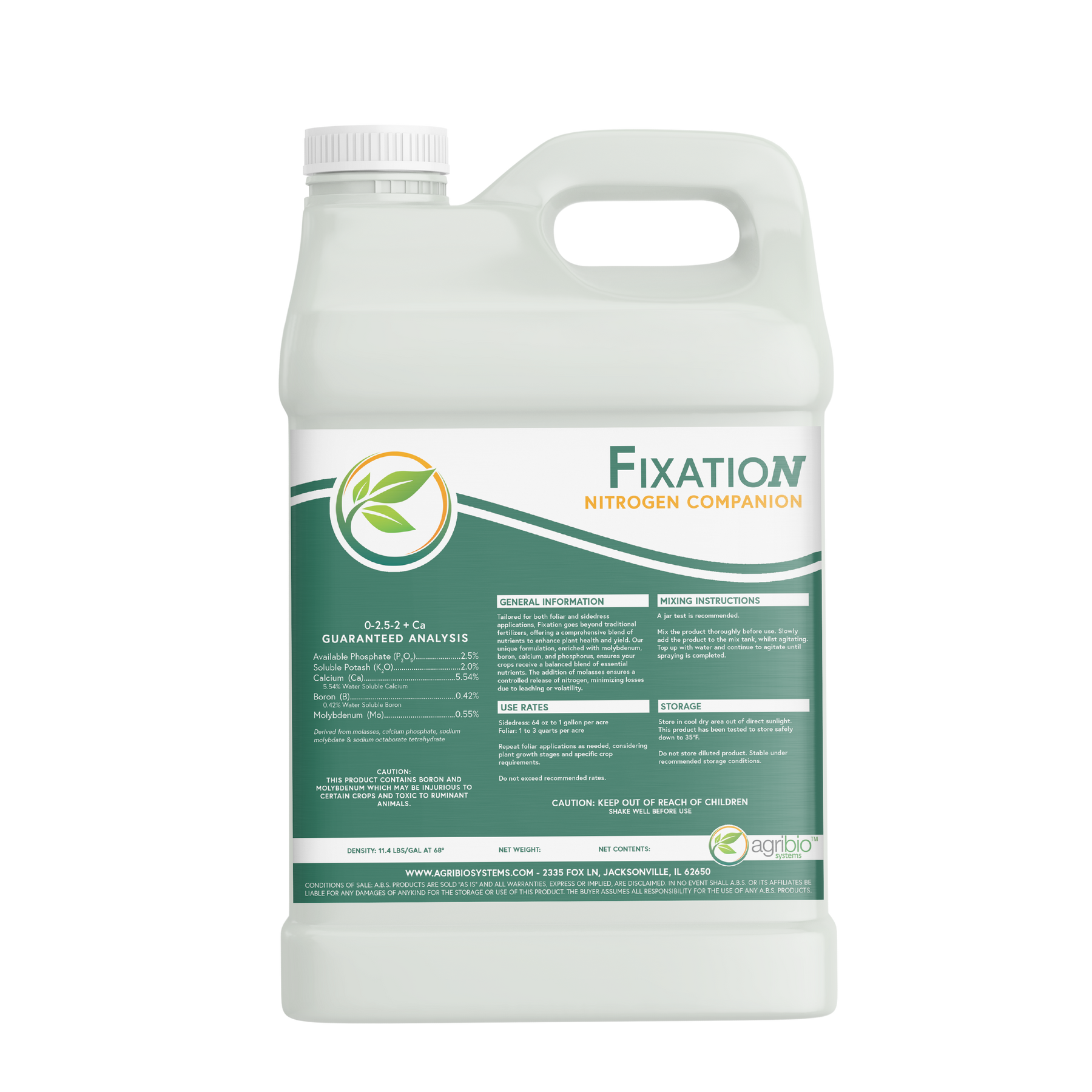
Balanced nutrition, controlled release
FixatioN
A complete nutrient package built on molasses, so applied nitrogen releases gradually instead of all at once.
Nitrogen that arrives faster than the crop can use it is nitrogen you are about to lose. FixatioN uses molasses as a carbon carrier to slow that release, cutting the exposure window for leaching and volatility and keeping more units in the field long enough to matter.
The nutrition riding along is not filler. Molybdenum drives the enzyme that reduces nitrate in the plant, boron moves it, calcium builds the tissue that holds it and phosphorus pays for the energy. Miss any one and conversion stalls no matter how much nitrogen you applied.
- Applied
- Sidedress or foliar
- Sidedress rate
- 64 oz to 1 gal per acre
- Foliar rate
- 1 to 3 qt per acre


Foliar nitrogen
ConversioN
Amine form nitrogen enriched with humic acid, taken up through the leaf at rates soil applied nitrogen cannot match.
Amine nitrogen costs the plant less energy to use than nitrate does, which means more of the sugar the canopy makes goes into growth instead of into processing fertilizer. Applied foliar, absorption can reach eighty percent, and it happens in hours rather than waiting on soil moisture and temperature.
The humic acid does the second job: it stabilizes nitrogen against volatilization and leaching, supports soil structure and keeps microbial activity going in the zone where the rest of your program is working.
- Applied
- Foliar, in season
- Timing
- Vegetative growth
- Uptake
- Up to 80 percent foliar


Liquid humic acid
C 12%
Twelve percent humic acid, mixed with liquid nitrogen at two and a half to three percent of solution.
Nitrogen without carbon is a bill. Nitrogen with carbon is a resource the soil can hold. C 12% chelates applied nutrients so they stay available, buffers the salt load your crop feels at application, and feeds the fungal and bacterial populations that do the actual holding.
It is the simplest change in this program, the cheapest, and usually the first one growers make. Include it with every nitrogen application and the rest of the program has something to work with.
- Applied
- Preplant and sidedress
- Rate
- 2.5 to 3 percent of solution
- Roughly
- 32 oz to 5 gal per acre
Running it
Build the program around the nitrogen you already apply.
Nothing here asks you to change your source, your equipment or your timing in year one. Start by adding carbon to the pass you are already making.

-
Start with your total N plan
Work from the volume of nitrogen product you apply, not units of N. Rates in this program are a percentage of that volume.
-
Add carbon to every pass
C 12% at 2.5 to 3 percent of solution with each liquid nitrogen application. This is the step that changes retention most.
-
Meter the release
FixatioN at sidedress, 64 oz to 1 gal per acre, or foliar at 1 to 3 qt per acre.
-
Pair with sulfur
Nitrogen conversion into protein needs sulfur alongside it. Add ConversioN foliar when in season demand outruns what the soil is supplying.
-
Measure, then reduce
Use sap or tissue analysis in season. Once the numbers hold, step total applied nitrogen down on a strip and compare.
| Product | Rate | Where it goes | When |
|---|---|---|---|
| C 12% | 2.5 to 3% of solution | With liquid N | Preplant and sidedress |
| FixatioN | 64 oz to 1 gal per acre | Sidedress | In season |
| FixatioN | 1 to 3 qt per acre | Foliar | In season |
| ConversioN | See label | Foliar | Vegetative growth |
Rates taken from current product labels. Confirm the ConversioN rate before publishing. Always jar test the full mix at field rate and do not exceed label rates.
Cutting nitrogen only works if the field can hold what is left.

Measure it
Tools that tell you whether it worked.
Plant Sap Analyzer
Upload a sap report and see nitrate, ammonium and trace levels against crop specific ranges.
Open tool Free toolHaney Soil Test Analyzer
Read a Haney report in plain language, including the nitrogen your biology is already supplying.
Open tool Free toolTank Mix Checker
Check order of operations and known compatibility issues before you fill.
Open toolNext step
Run the strip before you cut the rate.
Pick one field. Leave your standard nitrogen program on most of it and run the full stack at a reduced rate on a few passes. Sap test both in July. Weigh both in October. We will help you set it up and read it.
Nitrogen efficiency guide
Rates, tank order, sap benchmarks and a strip trial worksheet you can hand to an applicator.
Download the guide